
What is a dingo?
Dingoes are a distinct canine species (Canis dingo), not feral or domestic dogs. Scientific evidence dates them on this continent for at least 4,000 years, with some research suggesting closer to 10,000. Three regional types thrive across Australia: Desert Dingoes, Tropical Dingoes and Alpine Dingoes, each adapted to its environment.
Dingoes have lived alongside First Nations communities for millennia as a respected totem-animal and ecological partner. They have never been domesticated in the way we understand domestication. They are top-order native predators, and they belong here.
Our Dingo Awareness Centre exists to tell that story properly, through school excursions, community education, our book Dawn of a Dingo Day, and ongoing work alongside the Australian Dingo Foundation.
Dingoes are not wild dogs
The “wild dog” label is one of the most damaging misconceptions in Australian wildlife. It has driven decades of poison baiting, trapping and shooting, and the resulting collapse of ecosystems wherever dingoes have been removed is visible in exploding numbers of kangaroos, foxes and feral cats.
The story echoes the wolf in Europe and North America. Generations of vilification pushed the wolf to extinction across continents. Many of those countries have since reintroduced wolves successfully, using proper fencing, livestock guardian programs and government-funded loss cover, and the ecosystems have rebounded.
Australia hasn’t taken that step at the same scale. Outside the Northern Territory and a handful of other regions, the dingo still faces legal extermination. The science is unambiguous: dingoes are Canis dingo, recognised as a distinct canine species, and they are the keystone predator this continent needs.
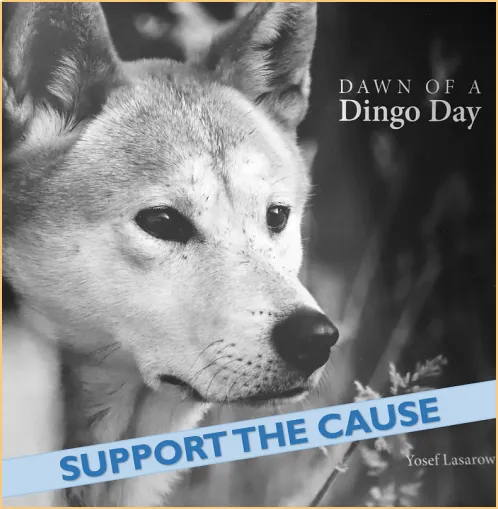
Dawn of a Dingo Day
Dawn of a Dingo Day is a short, beautifully illustrated booklet written by Yosef Lasarow. It is well-researched, easy to read in one sitting, and covers the true nature of the dingo, its role as the continent’s keystone predator, and the ongoing debate around its protection and reintroduction into national parks.
The book features a foreword by Lyn Watson (director of the Australian Dingo Foundation), photography from prize-winning wildlife photographer Gaz Meredith, and editorial guidance from prize-winning author Favel Parrett. Every Australian should read it.
Purchase a copy and become a dingo advocate. All proceeds go directly to our Dingo Awareness campaign.
Dingo conservation
and the Awareness Centre
We’ve established the Dingo Awareness Centre to bring this conversation to the Australian public. We work in partnership with the Australian Dingo Foundation, publish Dawn of a Dingo Day, host school and community education sessions, and contribute to a nation-wide campaign to change how dingoes are perceived and protected.
Our ultimate goal is mandated protection for the dingo across every Australian state, recognised properly as a native keystone predator. All proceeds from book sales, encounters and our broader awareness work go directly into the movement.
Meet a dingo in person
Reading and looking is one thing. Standing inside the enclosure while a trained keeper introduces you to a dingo is something else entirely. Our dingo encounters run every hour, 7 days a week.
Choose a 10-minute Express Encounter or a 30-minute Deep-Dive. Sessions cap at 10 guests and they do fill, so booking online is recommended.
School excursions and group education
Education is the key. The dingo conversation extends well beyond the dingo itself. It runs through ecology, agriculture, policy and First Nations history, and we believe every Australian school student should hear it.
After more than a decade of working with and learning from dingoes, we’ve come to understand how central this animal is to ecological stability, and what coexistence with the farming industry actually looks like in practice. Working dingo models in Australia and overseas show that harmony between farmers and native predation is achievable. It just takes a better understanding.
We invite schools, community groups, the farming industry and curious individuals to join us for a guided dingo discussion paired with a hands-on dingo encounter. Sessions can be tailored to your group’s interests, whether that’s ecology, conservation policy, dingo behaviour, or coexistence with livestock.
Online Bookings
Individuals and small groups up to 10 guests per session can book online via the button above.
School groups, larger groups and bus tours: please use the enquiry form below for a tailored quote and timing.
Over the counter
Bookings can also be made at the front desk on arrival, though sessions are limited to 10 spots so online booking is safer.
Recommended ages
The dingo educational discussion is recommended for children aged 12 and up because the content is involved. The hands-on encounter is open to ages 6 to 14 with a paying adult. Conditions apply.